Cave Guide
AI wine cellar management: what it means and what to expect
Every wine app claims AI now. This guide explains what AI wine cellar management actually does, where it is genuinely useful, and where it should still defer to expert sources.
Every wine app claims AI now. The word appears in App Store descriptions, feature headlines, and marketing copy across the category — often without explanation of what it does or why it matters. The result is a category where "AI" has become noise rather than signal.
This guide cuts through it. It explains what AI wine cellar management actually is, where the technology is genuinely useful for collectors, where it falls short, and what a well-built AI cellar app should be honest about.
What AI wine cellar management actually means
The term covers several distinct capabilities that are often grouped together but work differently.
Label recognition identifies a wine from a photo of its label. Older apps approached this like a scanner — reading characters one by one, failing on stylised fonts or anything less than a perfectly straight shot. Modern label recognition works more like recognition: the model understands the label as a whole, matching producer, appellation, vintage, and cuvée even from a difficult angle, a partially torn label, or typography that no character reader could parse reliably. This is the most mature AI capability in wine apps and works well across major producers and appellations.
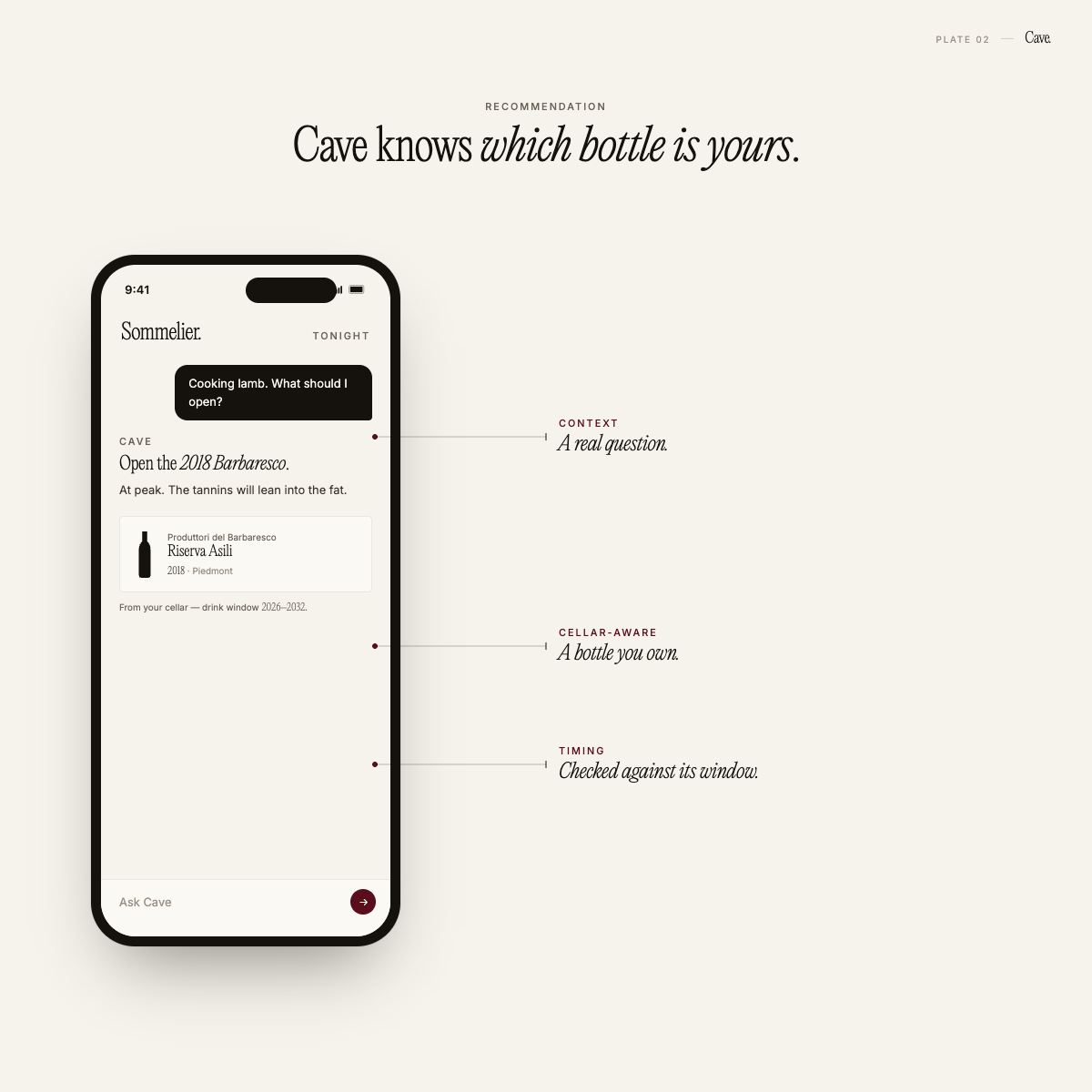
Natural language chat lets you ask questions about your cellar in plain language — "what should I open with lamb?" or "which of my bottles is most ready to drink?" — and receive answers drawn from your specific collection rather than a generic database. The quality of this depends on how well the app knows your collection and how the underlying model has been trained on wine knowledge.
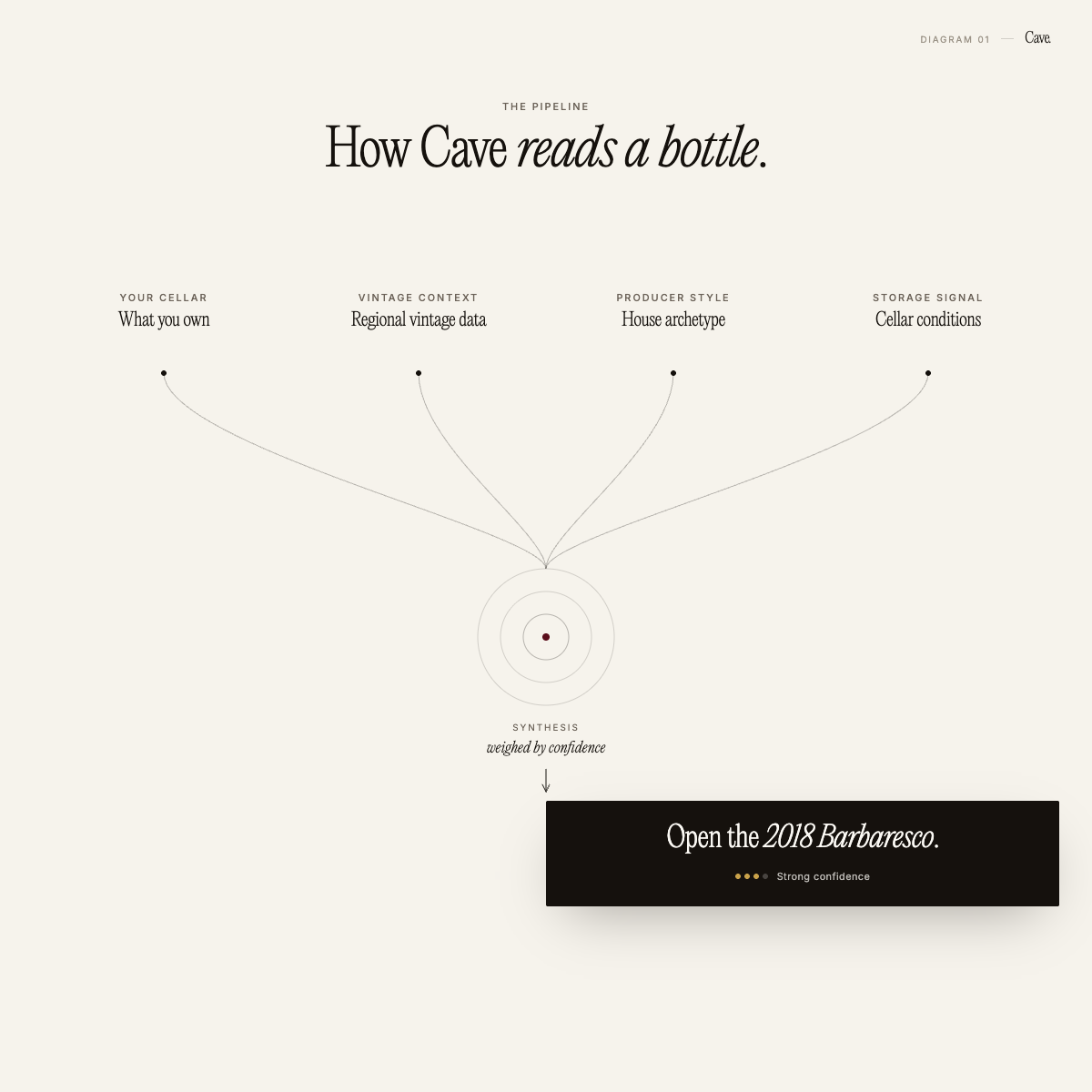
Personalised recommendation goes further than chat. Rather than answering a specific question, a recommendation capability looks at your cellar, your drinking history, and your taste profile, and proactively suggests decisions — what to open next, what your collection is missing, which direction to take a buying decision. A well-built agent does not wait passively for data to accumulate: it draws on your notes, your previous conversations, and your drinking history to form a picture of your palate — and where that picture has gaps, it asks rather than guesses.
Maturity and ageing guidance uses structured data about appellations, vintages, and producer styles to estimate when a bottle will reach its drinking window and when it will start to decline. This can be augmented by machine learning, but the core methodology is more rule-based than the other capabilities above.
How AI cellar management differs from a standard wine app
A standard wine app — even a well-built one — is a database. It knows what you have, what critics have said about it, and what the community has tasted. It answers questions you ask, and the answers are the same for everyone who asks them.
An AI cellar app changes the unit of analysis from the wine to the collector. The same bottle, in two different cellars, should generate different guidance — because the two collectors have different histories, different palates, and different gaps in their collections.
This distinction matters most at the point of recommendation. When a collector asks "what am I missing?" a database returns generic category suggestions. A well-built AI cellar app returns something specific to that collector: you have depth here, you prefer these styles, and based on your notes the gap that would serve you best is here.
That level of specificity is not possible from crowd consensus alone. It requires knowing the collector, not just the community.
What AI can do well for collectors
Reading labels accurately. Computer vision on wine labels is mature technology. A well-trained model handles most commercial labels, including producers with complex or stylised typography, and returns structured data reliably. This eliminates manual entry, which matters most for collectors adding bottles regularly.
Answering questions across a large cellar. A 300-bottle cellar is difficult to hold in your head. AI makes it searchable in natural language — "do I have any Right Bank Bordeaux ready to drink in the next two years?" returns a specific answer from your bottles, not a category overview. This is where cellar knowledge becomes practical rather than archival.
Identifying patterns you have not noticed yourself. A collector who consistently rates tannic, savoury reds highly may not have articulated that preference explicitly. An AI cellar app that tracks drinking history and ratings can surface that pattern and use it to shape buying suggestions. This is the gap analysis capability — the app knows things about your palate that you have not consciously identified.
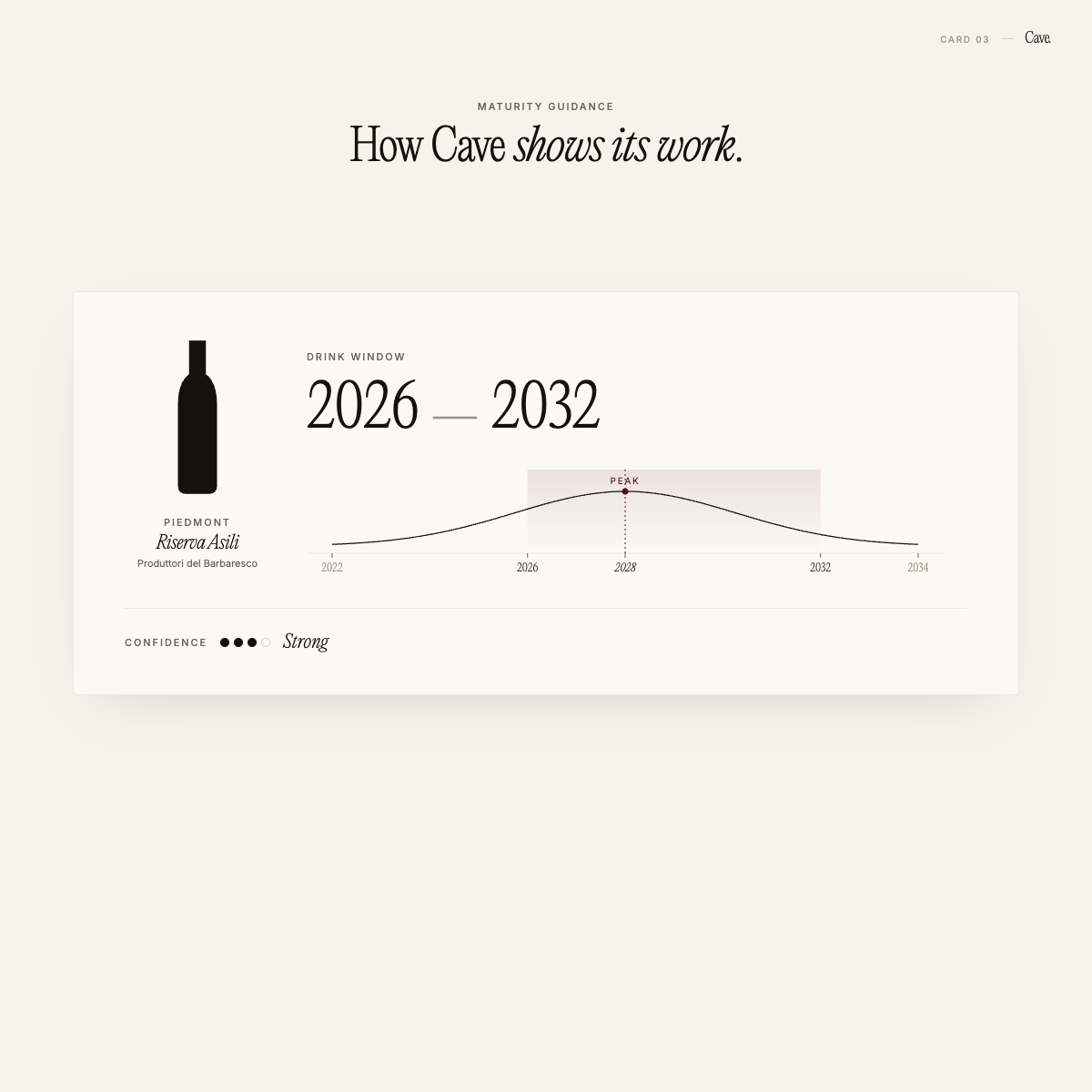
Drinking window guidance at appellation level. AI can combine structured appellation data with vintage quality modifiers and producer context to give guidance that goes beyond a single community consensus figure. A well-calibrated system can distinguish between a village-level producer and a premier cru from the same appellation, and adjust the window accordingly.
Where AI should defer to expert sources
There are areas where AI guidance should be held to a higher standard of honesty — and where the best tools are transparent about their limitations.
Obscure producers and limited-production wines. Label recognition and appellation databases are only as good as their training data. For well-covered producers, AI guidance is reliable. For small-production, artisan, or non-mainstream wines, the model may have limited data and should say so rather than generating a confident-sounding answer from thin evidence.
Specific vintage variation within an appellation. Vintage charts and regional guides reflect broad consensus. Within any given vintage, individual estates can produce wines that diverge significantly from the appellation average — a château that picked early in a rain-affected year, or a producer who consistently over-delivers in so-called off vintages. An AI system trained on aggregate data may miss this variation. Consulting producer-specific critic notes alongside any AI guidance is always sensible.
Cellar condition adjustments. A drinking window estimated for perfect cellar conditions (12–14°C, no vibration, high humidity) changes materially if the storage has been inconsistent. AI systems rarely have access to your physical storage data. Any window estimate should be understood as a starting point, not a guarantee.
Futures and unreleased vintages. AI systems work from historical data. Guidance on en primeur wines or very young vintages reflects pattern-matching from similar vintages rather than actual tasting data on those specific wines. Treat AI guidance on young vintages as directional rather than definitive.
Who benefits most from AI cellar management
The collectors who gain most from AI cellar management are those who have moved past basic inventory and want the app to participate in their collecting decisions, not just record them.
Collectors with 100 or more bottles find the decision-support most useful. Below a certain size, a cellar is manageable mentally. Above it, the combination of bottles, vintages, appellations, and drinking windows exceeds what most people track comfortably. AI makes that complexity navigable.
Collectors who are actively building rather than simply maintaining — buying, trading, looking for gaps, developing in new regions — use AI guidance to direct those decisions. The gap analysis function is most valuable to a collector who is shaping their cellar intentionally rather than accumulating opportunistically.
Collectors who want to make better use of what they have use AI chat for practical decisions: what to open tonight, what pairs with a specific dish, which bottle in the cellar is most appropriate for a specific occasion. These are questions where personal context — what you have, what you like, what you have already drunk — matters more than general knowledge.
Collectors whose primary need is community validation — crowd tasting notes, shared drinking windows, the collective record — will find traditional community-driven apps more useful than AI-first tools. Market data is a different story: an AI agent can search merchant sites and public auction results effectively, but the most authoritative price data tends to sit behind closed feeds and subscription services rather than open web. That gap will likely narrow as data access improves. For now, AI cellar management is most powerful when the goal is personal curation rather than market intelligence.
What to look for in an AI cellar app
Before choosing an AI cellar app, it is worth asking a few specific questions of any product you evaluate:
What data does the AI draw on? Community databases and personal history produce different outputs. Know which one is driving the recommendations you receive.
How does the app handle uncertainty? A trustworthy AI system says "I have limited data on this producer" rather than generating a confident answer from thin evidence. Overconfidence in AI guidance is a signal worth watching for.
What is the source for drinking window estimates? Methodology that combines appellation data, vintage modifiers, and producer context is more reliable than a single community consensus figure, especially for wine outside mainstream appellations.
Does the recommendation capability require enough personal data to be meaningful? Gap analysis and palate-based guidance require a meaningful drinking history to function well. An app that claims to know your palate from five logged bottles is overstating its capability.
Frequently asked questions
What is AI wine cellar management? AI wine cellar management uses machine learning and language models to provide collectors with personalised guidance — drinking windows calibrated to their specific bottles, recommendations based on their palate and drinking history, and analysis of their collection's gaps and strengths. It differs from community-driven apps in that the intelligence is built around the individual collector rather than aggregated crowd data.
How does AI predict a wine's drinking window? A well-built system combines structured appellation data (the historical drinking range for wines from a given region and producer tier) with vintage quality modifiers (was this a warm, structured year or a lighter, earlier-drinking one?) and producer context (is this a house that builds wines for the long term or for earlier consumption?). The result is a window calibrated to the specific bottle rather than a generic appellation average.
Is AI wine guidance better than crowd-sourced drinking windows? For mainstream, well-covered wines, community-derived drinking windows are reliable and draw on genuine consumption data. For personalised guidance — which of your specific bottles is ready, what your palate suggests about when to open something — AI guidance that knows your collection and drinking history goes further than community consensus.
What data should an AI wine cellar app use? Your own drinking history, your ratings, your notes, and the specifics of your collection (appellation, vintage, producer tier, quantity, when you bought it). Combined with structured appellation and vintage data, this personal layer is what separates AI cellar guidance from a standard wine database.
Can AI help me manage my cellar? In two practical ways. First, natural language: instead of navigating menus and filters, you ask directly — "do I have any Barolo ready to drink?", "what pairs with venison tonight?", "show me everything I bought in 2022" — and the app answers from your actual bottles. Second, gap analysis: a well-built AI can look across your collection, identify where it is thin or unbalanced relative to your palate, and suggest specific bottles that would fill those gaps well. These two capabilities — conversational access and proactive curation — are what separates an AI cellar companion from a standard inventory app.
Can AI recommend the best bottle from your own cellar? Yes — this is one of the most useful practical applications. An AI system that knows your cellar and your preferences can answer "what should I open tonight with X?" with a specific bottle from your actual collection, ranked against your taste history and drinking windows. This is meaningfully different from a generic pairing suggestion.
Cave knows your cellar, your palate, and exactly what your collection is missing — across 234 appellations and 24 regions.
See how Cave knows your cellar